Statement of Ethics and Transparency
Our study upholds ethical standards by ensuring participant well-being and data integrity. All members of this research team have received certification from CITI training1 in conducting research with human subjects to ensure the confidentiality of all personal information, securely storing data and using it solely for research purposes. The results from our studies are solely made with the intent to contribute positively to campus event management, and all non-confidential data used to draw conclusions will be shared publicly with the community, promoting collaboration and informed decision-making. This commitment to ethics and transparency ensures that our research benefits the entire campus community while respecting the rights and dignity of all participants and any sensitive data.
1.1 Consent and Transparency
We include clear and detailed consent language in both our survey form and focus group communications, ensuring that participants understand how their data will be collected, used, and stored. Consent language (referenced from Brandeis University2) is included in our survey form (upon intake) and all focus group communications:
1. Survey Form [link]
2. Town Hall (Focus Group) Consent Form [link]3
1.2 Privacy and Confidentiality
All data collected from surveys and focus groups will be anonymized to protect participant identities. For town hall participants, a consent form will be provided outlining the study's two components: a survey (10-25 minutes) and a town hall meeting (1 hour). The consent form will inform participants of the potential risks, such as data leaks and the lack of full confidentiality during the town hall, where participants will agree not to share or link discussions to individuals, though confidentiality within the group cannot be guaranteed. Participants will also be informed of the benefits, including entry into a raffle for a $25 Amazon gift card and free food for town hall attendees. Data will be anonymized in reports and publicly shared, while identifiable data will be securely retained for analysis.
1.3 Avoiding Harm
Event planning and attendance are closely tied to personal and organizational priorities and student interests, and we will be mindful of this connection throughout our research. Any criticism or feedback shared during discussions will be handled carefully to ensure it does not inadvertently harm individual or organizational reputations both in our final deliverable and during our research process. Our feedback mechanisms will focus on systemic issues rather than singling out specific individuals or groups, promoting constructive and solution-oriented discussions.
3. Required submission from all Town Hall (Focus Group) participants.
Project Credibility and Support
2.1 Stakeholder Involvement
We engaged the Wellesley community and gathered data in the following 3 methods:
1. Focus group study (“Town Hall Meeting”) held on December 5th from 4:30pm – 6pm in Sci L039 open to the entire Wellesley community.
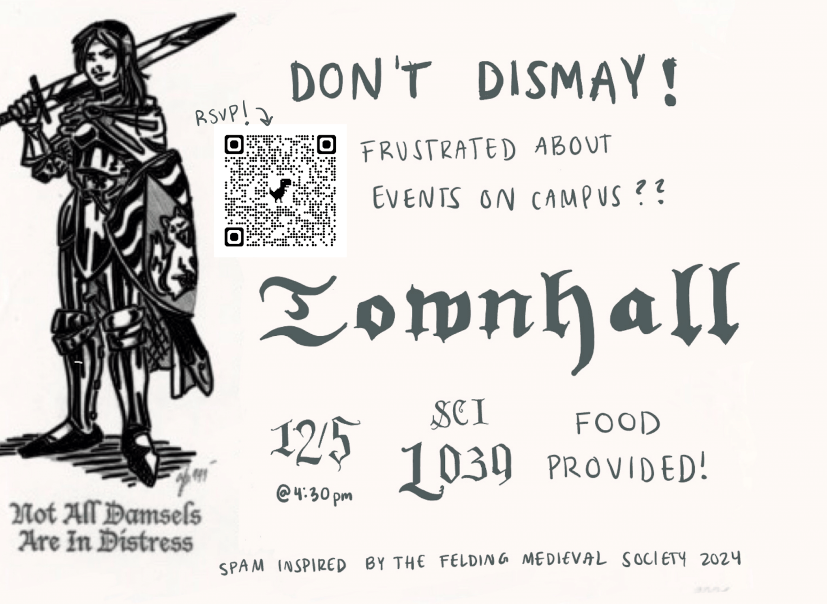
2. Conduct surveys via our Google Form, inviting all survey participants to also join our focus group event.
3. Aggregating event spam from all archives and active student organizations.
We summarize the makeup of our research demographic in 3 key stakeholder groups: 1) the general student
population, 2) event organizers (not limited to student organization leaders), and 3) college administrators
who assist with campus-wide scheduling and venue reservations.
Students — General student population, general members of student organizations (not in event planning).
• Share a survey through class email lists, newsletters, and social media platforms like Instagram, Sidechat.
• Posting physical spam in high-traffic areas such as the Lulu, Sci, and residence halls to encourage survey participation from a wide range of students.
• Town hall meetings provide a space for students to share their experiences attending on-campus events.
Event Organizers — Org E-board members, student workers supporting departments, CareerEd
• Direct outreach (personalized emails) to active student organization leaders (contacts identified through 25Live data in the current academic term).
• Town hall meeting for org E-board members and student workers to share their insights/ experiences in navigating event planning and event visibility/ communication.
• Inclusion of faculty/ staff in surveys to capture their perspective on event communication to students.
Administration — Faculty, staff, professors, and 25Live/Community Calendar administrators.
• Discussion contacts from the Office of Student Involvement to gather insights about available resources for hosting on-campus events.
• Collaboration with 25Live administrators to better understand the technical aspects of centralized event management and its limitations.
2.2 Alignment with Institutional Priorities
Upon learning that faculty in the college’s Public Affairs and Library and Technology Services Offices are actively exploring the development of a Community Calendar through a new intranet, designed to centralize event-specific information in a well-publicized and accessible digital space, we see a significant opportunity for our research to contribute meaningfully to this initiative. The proposed Community Calendar aims to reduce information fragmentation and enhance visibility for events across campus, addressing a concern frequently raised by both event organizers and attendees. Currently, student leaders—including those in CORA and Class Government, who play pivotal roles in overseeing student organizations—hold the authority to shape and enforce policies that govern student-held, on-campus events. This includes decisions related to event scheduling, communication, and managing issues such as event-related spam. Given the influence these leaders wield and the continuous development of community resources aimed at improving event communications, our research provides timely insights into student preferences and event trends. By identifying patterns in event timing, attendance, and overlap, as well as highlighting student preferences for event scheduling and communication strategies, we believe our findings can directly support the creation of these new resources. Specifically, our work offers evidence-based recommendations that can inform guidelines for event organization, improve outreach strategies, and enhance the overall student event experience.
Benefits & Sustainability
To measure the success of this project, we will track both objective and subjective metrics. Objective metrics will include the number of survey responses, event attendance data from organizers, and the aggregation of spam posting reach, which will help us assess how well events are being communicated and attended. Subjective metrics will include community feedback, student accessibility ratings, and overall satisfaction, providing insight into how well the event information is reaching and engaging students, and contributing to a greater sense of belonging on campus.
3.1 Immediate Benefits
The immediate benefits of this project will directly impact both event organizers and students. By collecting and analyzing our survey and Town Hall data, we will provide organizers with actionable insights to improve events promotion and outreach. Event organizers will benefit from a clearer understanding of how to better target their communication strategies, ensuring that more students are reached through the channels they use most effectively. For students, the improved communication and clearer event messaging will lead to greater accessibility and convenience, allowing them to better plan their schedules and attend events that interest them. The creation of our pamphlet will serve as a quick reference-guide that can be used immediately to refine current event promotion efforts.
3.2 Long-Term Impact
To ensure long-term impact, we will create a publicly accessible resource summarizing our findings, focusing on which communication channels are most effective in promoting events. This will include strategies and guidelines that event organizers can use to strengthen visibility based on our research, particularly addressing why some events may be disproportionately underrepresented. We will compile these strategies into a publicly accessible pamphlet, to be distributed across campus (both in a physical and digital format), outlining actionable strategies for navigating the current ecosystem of digital tech surrounding on-campus events that can improve event visibility. Additionally, we will have a more formalized technical documentation of our research methodologies, so the work can be continued and adapted in the future. By conversing with student organization leads and general students alongside our development of the deliverable, we aim to create a sustainable framework that ensures better event engagement and attendance moving forward.